
How a Collaboration With Philadelphia Gas Works Could Help Keep Students Safe
In September, fifty-two Philadelphia public schools dismissed students early as temperatures were forecast to hit 90 degrees. Among them was John F. McCloskey Elementary in Cedarbrook — a school that relies on inefficient and aging oil-fired boilers and has no central air conditioning. It's not the first time extreme heat has sent McCloskey students home.
There is a practical path to changing that.
Ground-source heat pumps — also known as geothermal heat pumps — can provide both heating and cooling by using the steady temperature of the ground. And a recently completed engineering study suggests they could also be the most affordable option to replace the aging HVAC system at McCloskey.
The Philadelphia Gas Works (PGW) Geothermal Feasibility Study, prepared by Alderson Engineering and released in July, evaluated McCloskey Elementary and the adjacent Dorothy Emanuel Recreation Center. Both buildings have aging HVAC equipment at its end of life, and lack central cooling. The study compared the cost of replacing their existing systems with geothermal heating and cooling against other options.
The results are encouraging. With federal energy tax credits available through Elective Pay, the geothermal option would cost $11.37 million for the two-building project, compared with $12.72 million for new natural gas heating and central air conditioning systems. The geothermal system is also projected to save roughly $75,000 annually in operating and maintenance costs at McCloskey.
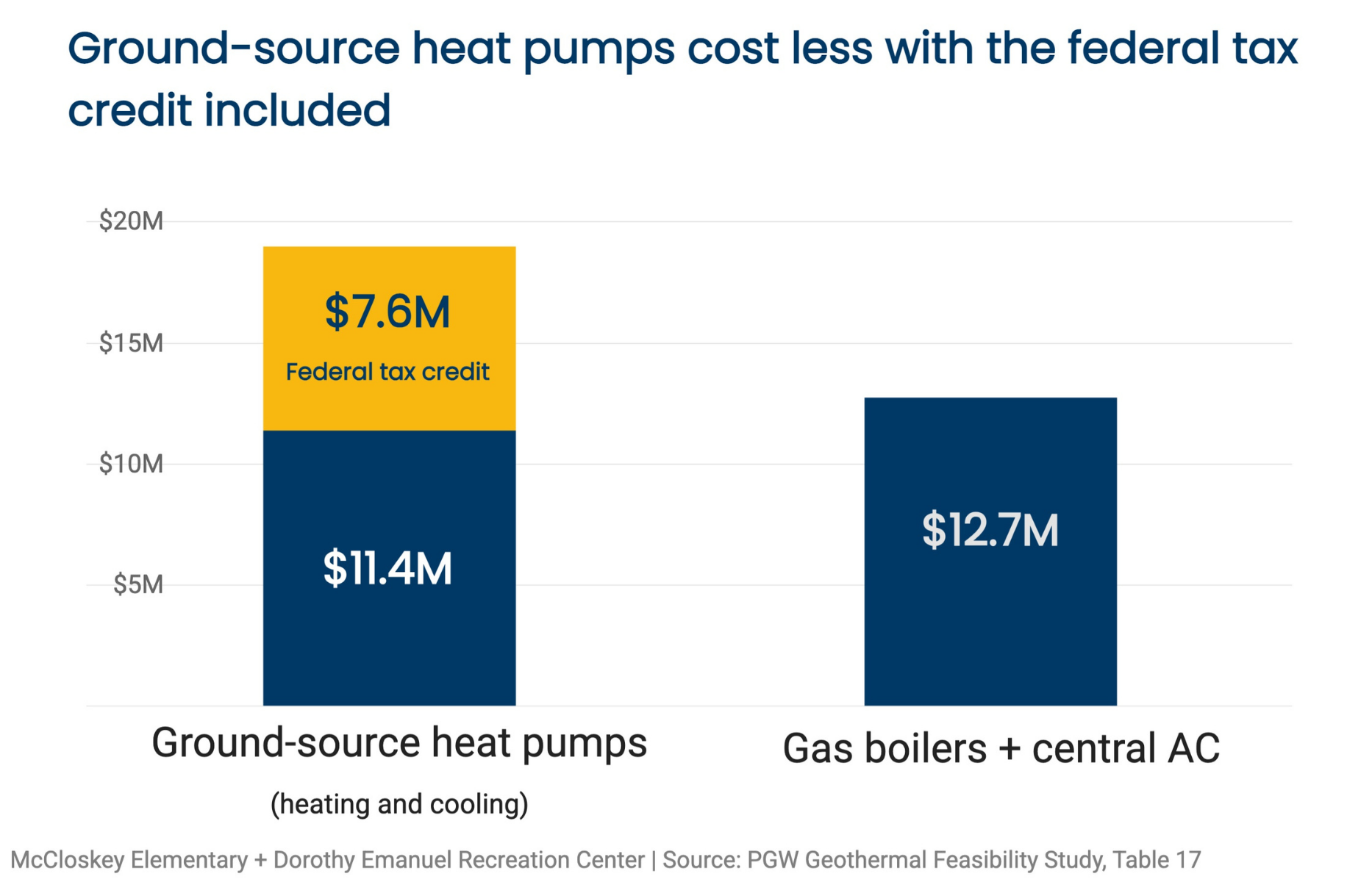
Bar chart comparing first costs: ground-source heat pumps at $11.4 million net of a $7.6 million federal tax credit, versus $12.7 million for gas boilers with central air conditioning.
The federal tax credit is an important part of the equation. Schools and other tax-exempt entities can earn a direct cash reimbursement through Elective Pay for eligible ground-source heat pump projects, typically covering 30% – and as much as 50% – of project costs.
The comparison also illustrates why it is important to think about heating and cooling together. Replacing only McCloskey’s heating system with natural gas would cost less upfront than geothermal. But the school needs cooling, too. When the full need is considered, geothermal becomes the lower-cost option, in large part because of federal tax credits.
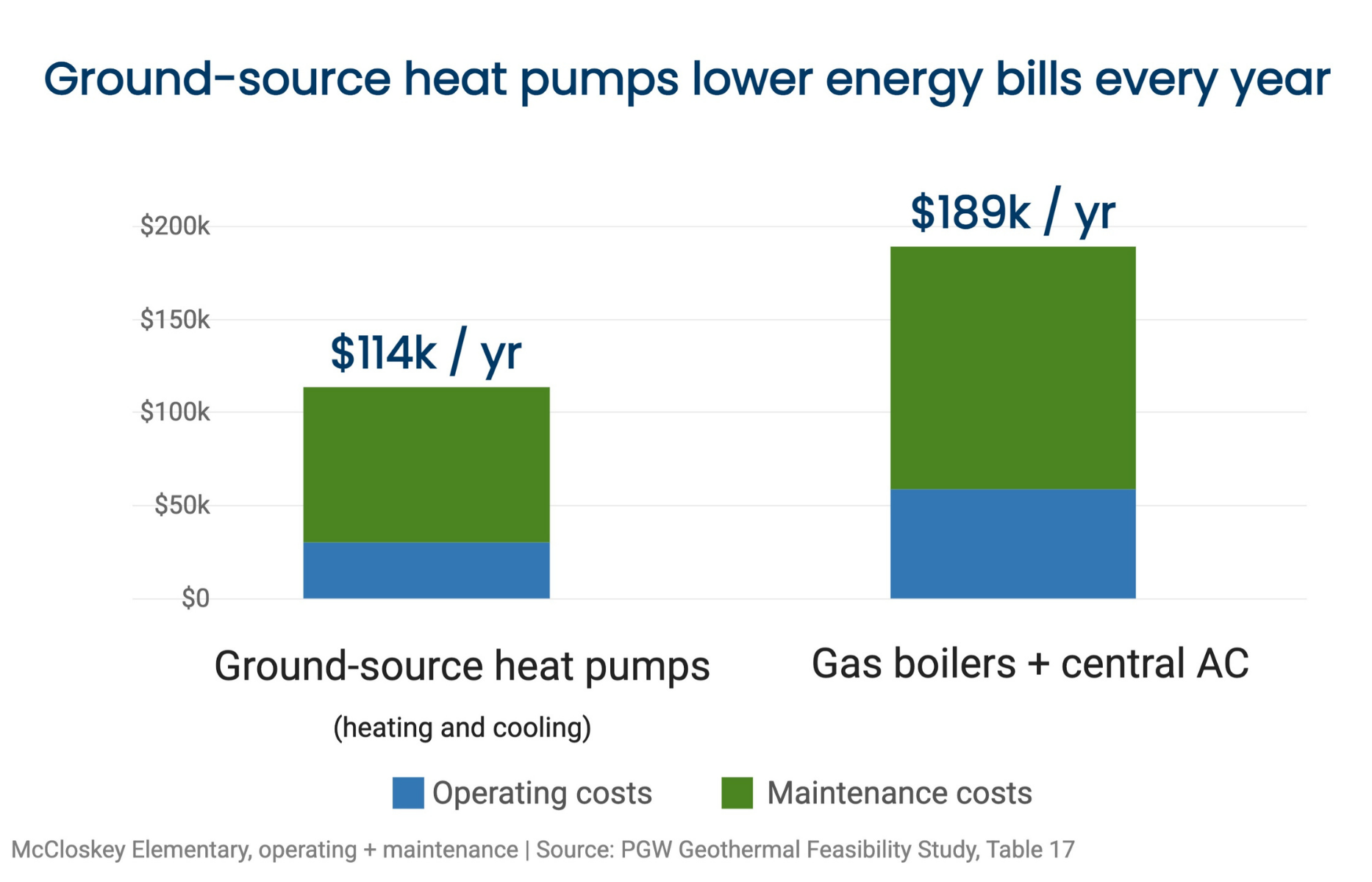
Bar chart comparing annual costs at McCloskey Elementary: $114,000 per year for ground-source heat pumps versus $189,000 per year for gas boilers with central air conditioning.
This study lands at the right moment. McCloskey's oil-fired heating system has exceeded its expected service life. The recreation center's rooftop units are 24 years old and original to the building. The geology under the site supports geothermal drilling, the land needed for the project is available on school property.
Bottom line: ground-source heat pumps are a cost-effective, technologically feasible solution to ensure students at McCloskey have classrooms that support in-person learning no matter what the temperature.
Engineering feasibility doesn’t address some remaining questions related to how the parties might share ownership and responsibility for maintaining the system and what financing approaches might be available. Another key consideration is how design choices today will impact opportunities for the utility to expand the geothermal system to serve the surrounding residential neighborhood.
But as the leading work in Massachusetts shows, utilities like PGW can chart new territory, and in doing so create new opportunities for them to serve customers.
We’re excited to see how PGW, the City, and district leaders collaborate to ensure that future generations of Philadelphia students have the opportunity to learn in safe, healthy, resilient classrooms.
And in the meantime, the district can explore other buildings where geothermal heat pumps may be a cost-effective solution to replacing old heating equipment and adding cooling.
School districts across the state can explore whether ground-source heat pumps can be a cost-effective solution for their next building project. Learn more about how districts like Pottsgrove and Upper Dublin have already received millions in federal support for making these upgrades.
