
Connecting with public education advocates at WPEN’s Summer Summit
Wisconsin Public Education Network’s Summer Summit in Superior brought together parents, educators, school board members, community members, and lawmakers from across the state to talk about what Wisconsin’s public schools need to thrive.
Held at Superior High School, the nonpartisan Summit created space for education advocates to focus on practical ways to support students and communities. Investments in clean energy and modern school facilities were an important part of that conversation. UndauntedK12 organized a panel featuring Carly Eaton, State Policy Manager for Wisconsin at BlueGreen Alliance; Nick Laubusch of McKinstry; Lori Blakeslee, Director of Communications for Green Bay Area Public Schools; and Kristen Hengtgen, UndauntedK12’s Program Director in the Upper Midwest, to discuss the role of school infrastructure in healthy learning environments. The session explored how districts can invest in modern HVAC systems like ground-source heat pumps, and other clean energy technologies like solar energy systems, to improve indoor air quality and classroom temperatures, lower energy and maintenance costs, meet sustainability or climate goals, and create learning opportunities for students.
Green Bay Area Public Schools is a powerful example of what this work looks like in practice. The district has committed to achieving 100% clean energy and carbon neutrality by 2050, driven by a board-approved clean energy resolution and a Clean Energy Advisory Committee that includes students.
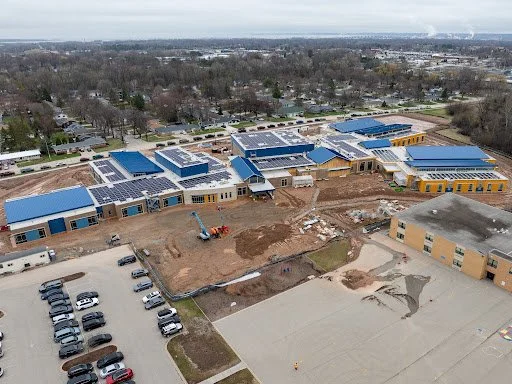
Green Bay Area Public Schools’ brand-new Starr Elementary, set to open in fall of 2026, featuring solar arrays, ground-source heat pumps, and other energy efficiency technologies.
The panel also acknowledged the very real financial pressures facing Wisconsin school districts. When districts are focused on keeping the lights on and making limited resources stretch, clean energy investments can sometimes be perceived as an additional expense. But modernizing school facilities can also be a strategy for addressing those challenges.
Energy-efficient HVAC systems and other clean energy technologies can reduce operating costs, improve indoor comfort and air quality, and help districts be responsible stewards of public dollars. These projects can also create opportunities for students to learn about emerging technologies and careers, and can simultaneously support good, local jobs.
Education advocates have an important role to play in that conversation. As Wisconsin districts plan major facility investments over the coming decade, community members can help champion projects that make schools healthy, resilient, and efficient, while strengthening local economies and creating learning opportunities for students.
See how schools across the Midwest are installing modern HVAC systems that lower emissions and save money:
See our panel’s slides from the Summer Summit
Watch WPEN’s Opening Session, featuring comments from Governor Tony Evers and Superintendent of Public Instruction Dr. Jill Underly
Check out Elective Pay in Action in schools nationwide