
New Report: California’s School HVAC Landscape
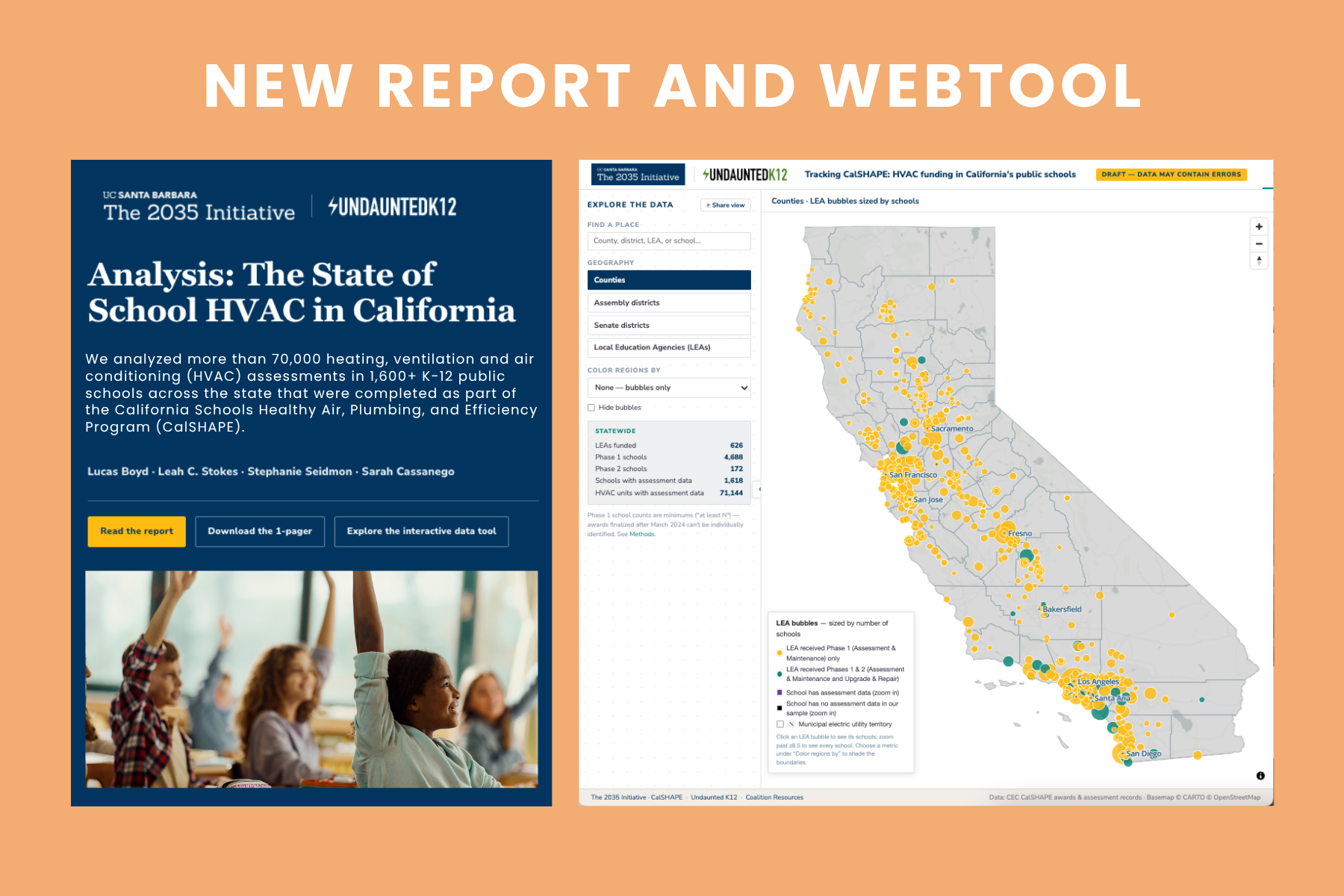
UC Santa Barbara’s 2035 Initiative and UndauntedK12 published a new report and interactive data tool analyzing assessments of more than 70,000 school HVAC units in over 1,600 California schools completed through the California Schools Healthy Air, Plumbing, and Efficiency (CalSHAPE) Program. The findings reinforce a hard truth: the systems meant to protect our children at school from a changing climate are too often failing them.
Here’s what we learned:
Most school HVAC systems should be replaced: more than half of assessed units were recommended for full replacement, and nearly three quarters have at least one problem that needs fixing.
About half of the assessed units cannot adequately filter wildfire smoke out of classrooms—leaving them unable to protect children and staff during smoke events until they’re repaired or replaced.
Most units can’t adequately ventilate classrooms: two-thirds of assessed units failed to deliver the outside air needed to prevent a buildup of pollutants and pathogens that threaten student and staff health.
Most assessed schools are located in underserved communities: two-thirds qualify as underserved according to the CalSHAPE statute, meaning these districts are often least able to fund HVAC replacements themselves and most dependent on 100 percent grant programs like CalSHAPE.
Our interactive tool lets you look up any school site or district that was part of the analysis to see exactly what was found—number of units assessed, replacement recommendations, ability to filter wildfire smoke, whether the unit burns fossil fuels, and more. You can also view the data by county or legislative district.
Note on Data and Methodology:
We analyzed unit-level HVAC assessment data from the California Energy Commission that covers 1,618 school sites across 252 LEAs — roughly one-third of all schools that participated in CalSHAPE. This reflects the data available at the time of writing, since assessment reports are still being completed and verified. As more data becomes available, we plan to extend the analysis to all participating schools and LEAs.
Read more about the analysis methodology on the report’s homepage.
